Skeletal Development of the Hand and Wrist by Gaskin Cree M.; Kahn S. Lowell MD MBA; Bertozzi J. Christoper
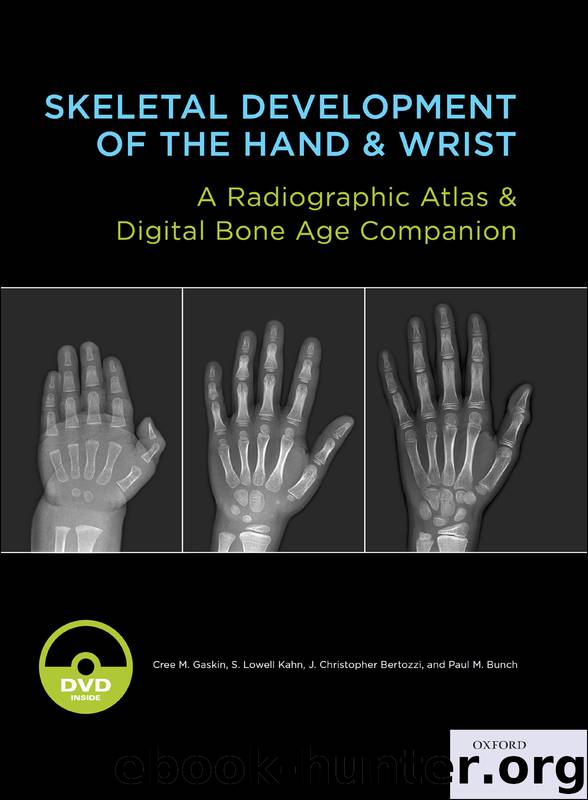
Author:Gaskin, Cree M.; Kahn, S. Lowell, MD MBA; Bertozzi, J. Christoper
Language: eng
Format: epub
Publisher: Oxford University Press
Published: 2011-04-07T04:00:00+00:00
Bone Age Equations:
ESA = Estimated Bone Age or Estimated Skeletal Age
CA = Patient’s Chronological Age
ACA = Adjusted Chronological Age (see 2a. above)
SD = Standard Deviation
Basic technique:
Normal skeletal development: CA – (2 × SD) < ESA < CA + (2 × SD)
Advanced skeletal development: ESA > CA + (2 × SD)
Delayed skeletal development: ESA < CA – (2 × SD)
Modified (longer) technique (includes step 2a. above):
ACA = CA + Modifier (modifier can be positive or negative)
Modifier = Mean skeletal age of test population – Chronological age of test population (see Tables 1-4)
Normal skeletal development: ACA – (2 × SD) < ESA < ACA + (2 × SD)
Advanced skeletal development: ESA > ACA + (2 × SD)
Delayed skeletal development: ESA < ACA – (2 × SD)
5.) This entire process can be simplified and enhanced by using the Digital Bone Age Companion software by Oxford University Press, which is available separately or bundled with this book. The Digital Bone Age Companion is a freestanding Windows™ application which further optimizes the bone age interpretation process. Users can easily zoom in on subtle radiographic features, set image level and width to their preference, and compare two or three reference standards side-by-side for those difficult cases that superficially look like adjacent standards (no more flipping pages back-and-forth!). Users will also be thrilled to abandon tedious manual calculations for automated and more reliable digital results via the flexible bone age calculator. Trainees will be enabled to rapidly and reliably interpret bone age studies with little attending support. Attending physicians will find resident check-out to be more pleasant and accurate. All users can further expedite their workflow by utilizing the built-in report generator, obviating the need to transpose data and potentially avoiding dictation altogether.
6.) Bone age practice examples:
a. Using the basic technique, determine the overall status of skeletal maturity (normal vs. delayed vs. advanced) of a 14-year-old boy whose hand and wrist radiograph matches that of the 13-Year Male Standard. Use the male data from the Brush Foundation Study (Table 1) to look up the standard deviation for a 14-year-old boy, yielding 10.72 months. Two times the standard deviation equals 21.4 months. The normal range of skeletal age is chronological age +/- 2 standard deviations. For a 14-year-old male, this is 168 months +/- 21.4 months, yielding a range of normal for the skeletal age of 146.6 to 189.4 months. The Estimated Skeletal Age for this patient is the age of the chosen 13-Year Male Standard or 156 months. Since the Estimated Skeletal Age (156 months) of the patient falls in the range of normal (146.6 to 189.4 months) for his chronological age, he is considered to have “normal skeletal development” and this is his bone age result.
b. Using the basic technique, determine the overall status of skeletal maturity of a 10-year and 9-month-old girl whose hand and wrist radiograph falls evenly between the 13-Year and 6-Month Female Standard and the 14-Year Female Standard. Her Estimated Skeletal Age is halfway between the two standards (13 years and 9 months or 165 months).
Download
This site does not store any files on its server. We only index and link to content provided by other sites. Please contact the content providers to delete copyright contents if any and email us, we'll remove relevant links or contents immediately.
The Art of Coaching by Elena Aguilar(53668)
Thinking, Fast and Slow by Kahneman Daniel(12537)
The Art of Thinking Clearly by Rolf Dobelli(10721)
The 5 Love Languages: The Secret to Love That Lasts by Gary Chapman(10015)
Mindhunter: Inside the FBI's Elite Serial Crime Unit by John E. Douglas & Mark Olshaker(9531)
When Breath Becomes Air by Paul Kalanithi(8603)
Periodization Training for Sports by Tudor Bompa(8419)
Becoming Supernatural by Dr. Joe Dispenza(8375)
Turbulence by E. J. Noyes(8219)
Bodyweight Strength Training by Jay Cardiello(8037)
Nudge - Improving Decisions about Health, Wealth, and Happiness by Thaler Sunstein(7862)
Therapeutic Modalities for Musculoskeletal Injuries, 4E by Craig R. Denegar & Ethan Saliba & Susan Saliba(7781)
The Road Less Traveled by M. Scott Peck(7737)
Mastermind: How to Think Like Sherlock Holmes by Maria Konnikova(7555)
Enlightenment Now: The Case for Reason, Science, Humanism, and Progress by Steven Pinker(7437)
Win Bigly by Scott Adams(7350)
Kaplan MCAT General Chemistry Review by Kaplan(7057)
Why We Sleep: Unlocking the Power of Sleep and Dreams by Matthew Walker(6857)
The Way of Zen by Alan W. Watts(6735)
